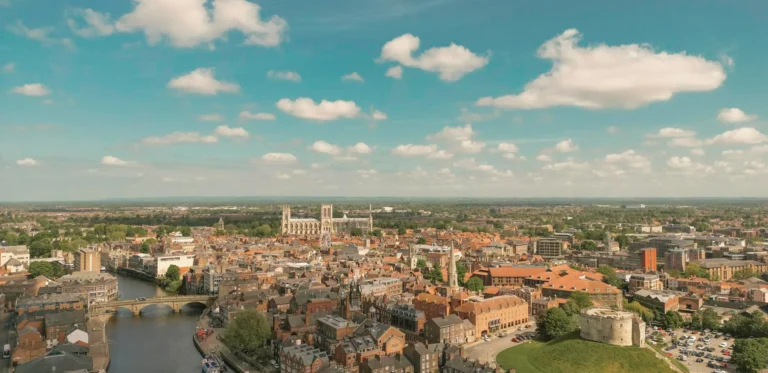
There are plenty of historic cities in England, but few wear their timeline as clearly as York. Walk a few streets and you can trace two thousand years of change: Roman foundations, Viking trade, medieval guild power, and a market culture that still shapes the city centre today. The story of York’s success is inseparable from commerce, especially the markets that helped the city feed itself, attract visitors, and turn passing footfall into a thriving local economy.
YORK’S ORIGINS: WHY THIS LOCATION MATTERED
York’s rise wasn’t an accident. The city sits at a strategic crossroads of land routes and waterways, including the meeting of the River Ouse and the River Foss. That geography made movement, supply, and trade easier long before modern roads existed. Access out toward the coast through connected waterways meant York could export local goods and import products from far beyond the region.
Roman York: Eboracum and a built-in trading advantage
The Romans established York in AD 71, creating a major northern centre known as Eboracum. With military presence came infrastructure: roads, bridges, workshops, and a growing civilian settlement. This helped York function as a hub for provisioning, craft production, and regional exchange.
VIKING YORK: JORVIK AND THE INTERNATIONAL MARKETPLACE
If Roman York laid the groundwork, Viking York supercharged the city’s commercial identity. By the 9th century, York, known to the Vikings as Jorvik, developed into a busy trading and manufacturing centre with strong overseas links. Evidence from archaeology shows the city’s connections reached far beyond Yorkshire, with goods and materials moving through long-distance routes.
This matters because a great market is rarely just a row of stalls. Markets grow where merchants can reach buyers reliably, goods can move in and out efficiently, and the city provides safety, rules, and trading rights. York hit all three early, and kept building on them.
MEDIEVAL YORK: CHARTERS, GUILDS, AND THE POWER OF TRADE
The medieval period is where York’s market culture becomes unmistakable. York wasn’t just a place with markets. It was a place where trading privileges, rules, and specialist crafts structured the city’s economy. Over time, trading rights and official permissions helped formalise buying and selling, while guilds and skilled trades shaped what was made, sold, and exported.
Market days and specialist markets
As York grew, markets became more specialised. Different areas and times were associated with different goods, helping trade run smoothly and making prices and quality easier to regulate. Specialisation is a classic feature of successful commercial cities because it makes buying and selling faster, fairer, and more predictable.
THE SHAMBLES: FROM MEAT MARKET ROOTS TO A CULTURAL ICON
One of the clearest links between York’s history and its market life is The Shambles. Historically, it was strongly associated with butchers and the meat trade. Shops and houses were arranged for practical, everyday commerce, with features designed around the realities of selling food in a busy medieval city. In other words, it wasn’t just a picturesque street. It was a working retail space in medieval form.
That’s why The Shambles remains so powerful today. It’s living evidence that commerce shaped York’s streetscape, not just its skyline.
YORK MARKET HISTORY: CONTINUITY AND REINVENTION
Markets survive when they adapt. York’s market story isn’t frozen in the Middle Ages. It’s a series of reinventions responding to the city’s changing needs. In the modern era, central market areas were reorganised to suit new patterns of shopping, footfall, and urban planning. That evolution reflects a simple truth: markets remain valuable when they match how people actually live.
WHY THE MARKET MATTERS IN YORK, THEN AND NOW
York’s market is important for the same reasons markets have always mattered in great cities: economic resilience, social connection, and place identity, with modern benefits layered on top.
1) Markets turn heritage into a living economy
Historic streets and landmarks bring people in, but markets convert visitors into active participants: browsing, tasting, buying, chatting, and returning. In a city defined by history and tourism, the market is one of the most direct ways people support local traders.
2) Small businesses get a launchpad
Market stalls can be a first step for entrepreneurs. They offer lower overheads, steady footfall, and fast feedback from customers. That matters in a city centre where permanent retail units can be expensive and risky.
3) Local food and everyday affordability
Markets traditionally exist to feed cities. Even as York has grown into a major visitor destination, the market function still matters for locals who want quick, varied options in the centre, as well as for visitors looking for a convenient bite between attractions.
4) Markets preserve the “York feel”
What makes York memorable isn’t only the walls, the lanes, or even the Minster. It’s the feeling that the city centre is alive. Markets add sound, smell, spontaneity, and human scale in a way static attractions cannot.
5) A direct line to York’s trading DNA
From river-based trade and long-distance connections to regulated medieval market spaces, York’s prosperity has long been tied to the movement of goods and the concentration of buyers. The modern market continues that tradition, just with different products and a different crowd.
THE SHAMBLES MARKET TODAY: A MODERN EXPRESSION OF AN OLD TRADITION
Today’s city-centre market culture is often experienced through the Shambles Market area, which offers a modern version of what York has always done well: bring people together in the heart of the city to buy, sell, eat, and explore. For visitors, it’s a quick, authentic “taste of York.” For locals, it’s part of the working fabric of the centre. For the city’s identity, it’s proof that York isn’t only about looking back. It still trades, eats, and meets in the same central heartbeat.
FAQ: QUICK ANSWERS
How old is York?
York has over 2,000 years of recorded history, beginning with the Roman foundation in the 1st century.
What was York called in Viking times?
Viking-era York is widely associated with the name Jorvik.
Why were markets so important to medieval York?
Because trading rights, regulation, and specialist crafts created predictable places and times for exchange, helping York thrive as a regional commercial centre.
What is The Shambles famous for historically?
It was historically associated with butchers’ shops and the meat trade, and that commerce helped shape the street’s layout and features.
CONCLUSION: YORK’S MARKET ISN’T “EXTRA”, IT’S THE POINT
York’s history is often told through emperors, invasions, walls, and cathedrals. But the quieter truth is that the city endured because people bought and sold here, again and again, across Roman, Viking, and medieval eras into the present day. York’s market culture is not a side story. It’s one of the most practical reasons the city stayed important, stayed populated, and stayed prosperous.